Hire for what
people can do
Situational questions from your job ad, every answer rated anonymously on five levels
Book a demo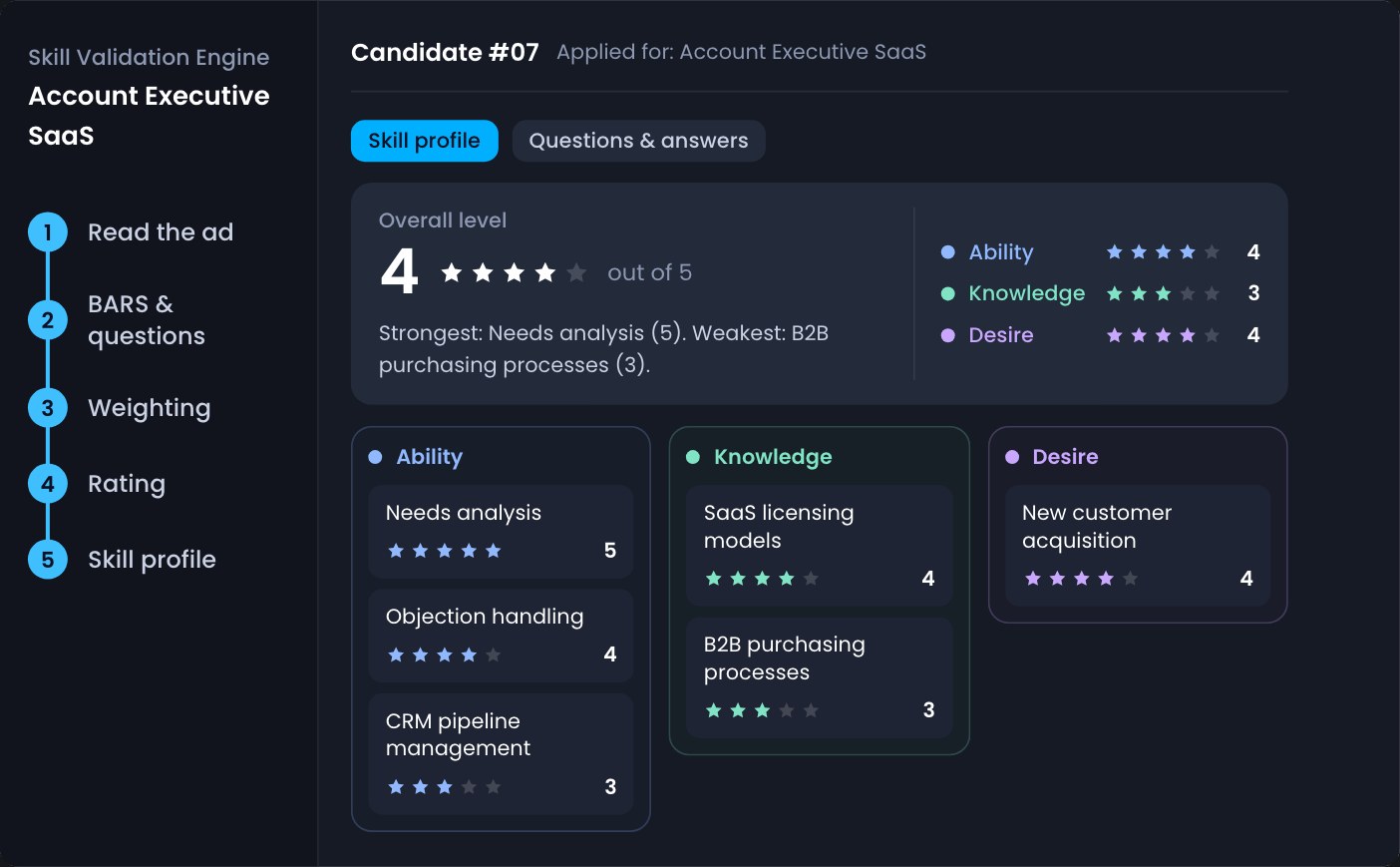
- 5BARS levels per skill, each with a behavioral anchor
- 2independent ratings per answer
- 0names in the profile, only pseudonyms
When every application looks good, what counts is what people can do
Applicants write with AI, companies filter with AI. The CV says less and less about who can do the work, and people without the usual career path drop out early.
- 291 applications per hire, three times as many as in 2021 Ashby Talent Trends 2026
- 11,000 applications arrive on LinkedIn every minute LinkedIn Economic Graph 2025
- 91% of recruiters come across AI-generated fake applications Greenhouse 2025
- 8× as many applications needed by international talent and career changers to get the same interview WEF Future of Jobs 2025, IZA
A CV shows what people write about themselves. Their answers show how they think.
From job ad to skill profile
The Skill Validation Engine reads your job ad, builds a BARS (Behaviorally Anchored Rating Scale) for every skill and derives situational questions from it. Every answer is rated against this scale. You get an anonymous skill profile, backed by quotes from the answers.
-
Reading the job ad
The engine reads your ad the way an experienced recruiter would: it identifies the skills the role requires, weights them by importance and assigns each one to one of three dimensions: ability, knowledge or desire.
- Every skill gets an importance from 1 to 5
- Key facts such as start date, location and salary are read as well
- If the engine is unsure, a person checks the analysis before the job goes live
-
Building the BARS and deriving questions
For every skill, the engine builds a Behaviorally Anchored Rating Scale. It first collects effective and ineffective behavior from everyday work, only what can be observed, no traits, and turns it into five behavioral anchors: one for each level.
- Retranslation, the check step of the BARS method by Smith and Kendall (1963): an independent run reassigns the shuffled anchors without their levels
- If a scale still fails on the third attempt, a person revises it
- Situational questions from the everyday work of the role build on each scale
-
Weighting the questions
Not every question counts the same. For each situational question you set a weight from 1 to 5: how much it counts within its dimension. The engine suggests it from the skill's importance in your ad.
- A weight from 1 to 5 for every situational question
- Suggested from your ad, adjustable by you
- You can also change the wording of every question
-
Rating the answers
Applicants answer in their own words, without a CV and without a cover letter. The engine rates every answer twice against the BARS of its skill: once with the levels from 1 to 5 and once from 5 to 1, so the order does not skew the result.
- If the two runs differ by one level or more, a third run decides
- Every rating quotes the passage of the answer it relies on
- If the evidence is missing, the model is unsure or someone tries to steer the rating, the answer goes to a person
-
Building the skill profile
The rated answers become the skill profile: every skill at its BARS level, ability, knowledge and desire, an overall level and a short evaluation written directly from the scores.
- The original answers sit right next to it
- A pseudonym instead of name and photo
- Strongest and weakest skill at a glance
A shortlist built on evidence, not polish
-
Rated the moment people apply
The questions come as soon as someone clicks Apply. You get skill profiles instead of a pile of CVs.
-
No CV. No cover letter.
People who can do the work get further, even without the right degree or a straight career path.
-
No name. No photo.
The profile shows a pseudonym and the skills. What counts is the answer, not who wrote it.
-
Every level with evidence
Every rating names the passage in the answer it relies on. You can check every level against the original.
-
A person for the unclear cases
The EU AI Act classifies AI in recruitment as high-risk. The engine logs every rating and passes uncertain cases on to you.
-
Methods from personnel assessment
BARS and structured situational questions are established methods. Structured interviews predict job performance about five times as well as years of education: r = .51 versus r = .10. Schmidt & Hunter, 1998
European AI for your applicant data
Creating questions, analyzing answers, evaluating skills: it all runs on Mistral AI, a European model. Built with data protection and digital sovereignty in mind.
-
A provider from Europe
Mistral AI is a company based in Paris. The engine uses Mistral for every step, from the job ad to the rating.
-
Only what the rating needs
For a rating, the model gets the question, the answer and the skill's BARS. Name and email address are not part of it.
-
A fixed model version
The engine calls a pinned version of Mistral Large, not an alias that changes overnight. Changing models is a deliberate decision.
-
Every call on record
For every rating, the engine stores the model, version, temperature and all runs. That way you can show later how a rating came about.
See what your applicants can do
In a demo, we walk you through the whole way: from the job ad to the skill profile.